Community Services District Project Updates

The Bear Valley Road Rehabilitation Project will include a complete reconstruction of Bear Valley Road from the gate to Oakflat Drive, and from Bay Court to Martingale Way. Water main lines and service lines will also be replaced as part of the project.
The current estimate for the project is $9.4 Million. The road replacement portion will be funded from the Roads Fund, and the water line replacement portion will be funded from the Water Enterprise Fund.
When construction begins, please expect delays on our roads. The CSD will utilize Nixle, the Electronic Gate Marquee, the CSD Website, and Social Media to send timely alerts on road closures.
- October 12, 2026 - A two-week full closure of Bear Valley Road inside the gate by the frontage roads begins. During this time, water pipes are being replaced and the road is being fully repaved.

- September 14, 2026 - Work officially begins on the Bear Valley Road Rehabilitation project, starting with replacing water lines from Oakflat Drive to the Entry Gate.

- August 13, 2026 - CSD Board of Directors authorizes construction contract with Bowman Asphalt.
- April 16, 2026 - Engineering firm Provost and Pritchard approaches 65% completion mark on design work
- December 17, 2025 - CSD Board of Directors Authorizes Agreement with engineering firm Provost and Pritchard to begin design work on Bear Valley Road Rehabilitation Project
- September 11, 2025 - CSD Board of Directors receives Bear Valley Road Rehabilitation Project Engineering Study, examining several options to determine the best and most cost-effective method for rehabilitation
- December 12, 2024 - CSD Board of Directors Approves Engineering Study for Bear Valley Road Rehabilitation
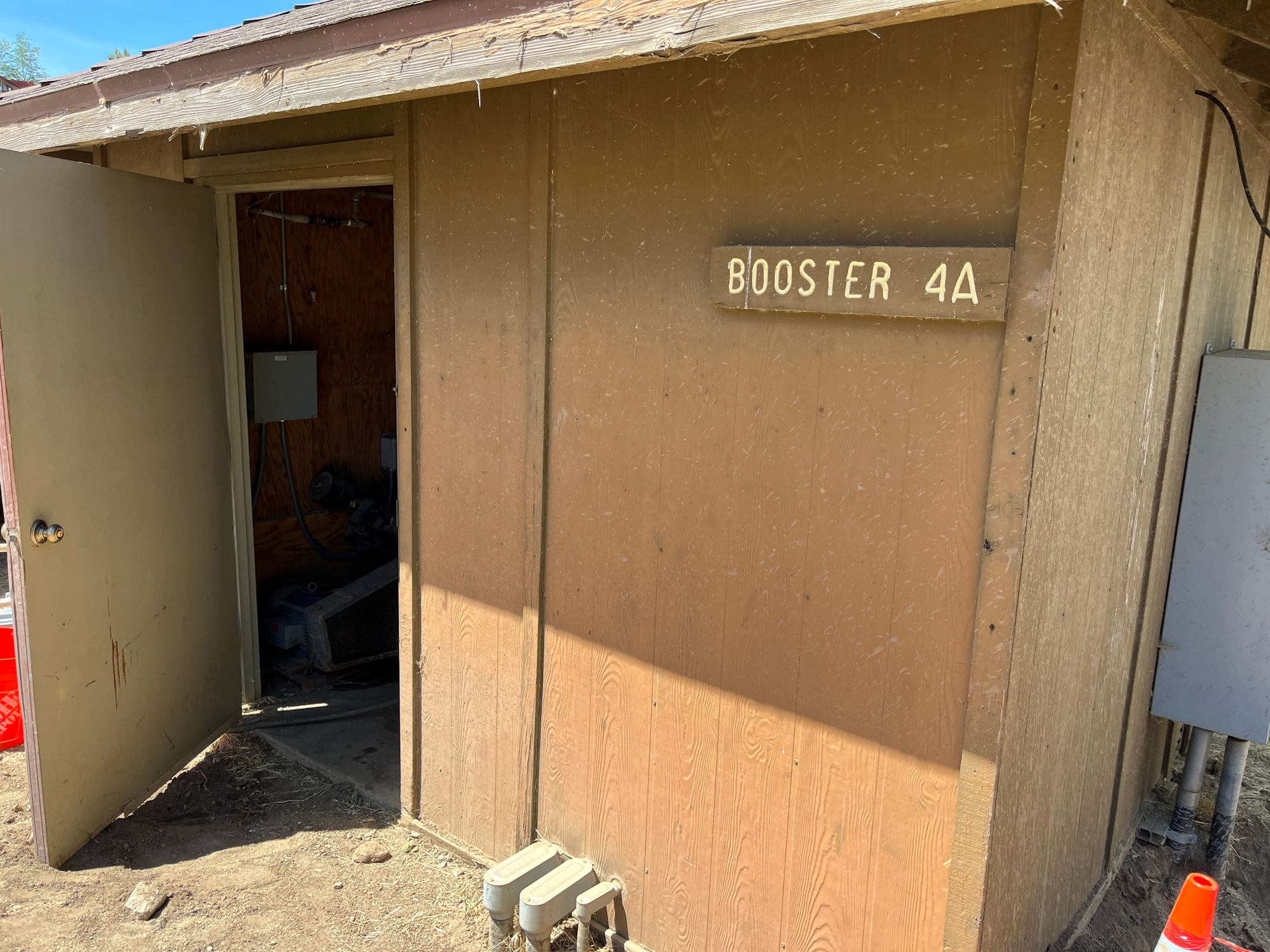
The Oakflat Booster Station pumps water to higher elevations in the surrounding area but had been experiencing pressure surges and water outages due to aging equipment.
The new booster system was officially brought online in March 2026. Remaining work includes full integration with the CSD’s SCADA system and installation of a shade structure.
Funded through water rates paid by Bear Valley Springs residents, the project will provide more reliable water service and improved water pressure for community members in the area.
- August 13, 2026 - CSD Board of Directors receives formal notice of completion on Oakflat Booster Station Project.
- March 2026 - Booster system activated
- May 19, 2025 - Construction begins on Oakflat Booster Station Project
- October 28, 2024 - Board of Directors authorizing General Manager to execute a contract with Elite Constructors for Oakflat Booster Project.
The Bear Valley CSD Pavement Management Project is focused on long-term rehabilitation of our roads.
On September 10, the Board of Directors received the final Pavement Management Report from Infrastructure Management Services (IMS).
Bear Valley Springs Pavement Management ReportThe report takes an in-depth look at the current condition of roads in Bear Valley Springs, using a Pavement Condition Index (PCI). The PCI is essentially the health of the road. Roads are examined for things like pavement cracking, rutting, and roughness. Once that data is collected, it is analyzed to give each segment a PCI score between 0 and 100. The higher the score, the better the condition of the road.
The final report found that Bear Valley's roads have an average PCI of 43, which falls in the “marginal” range. The report also put 23% of our roads in the "Good" or "Very Good" category, while 50% are in the "Poor" or "Very Poor" category.

IMS identified three key takeaways from this data:
- The network average pavement condition score falls below the national average currently seen by IMS of 60 to 65, with Bear Valley's average scoring 43.
- The number of streets rated Excellent is below the minimum recommended target of 15% at 0%.
- The backlog amount, which is the total of Very Poor and Poor roads (between a PCI of 0 and 40), is far above the maximum recommended target.
Simply put, roads in Bear Valley Springs are currently missing all three of these key metrics.
Funding Road Improvements
Currently, the CSD has a roads budget of $0.17 million per year. This is based on a Roads Assessment that was implemented in 1996 and hasn’t been changed since. Based on the analysis and projections by IMS, leaving that budget unchanged will lead to continued degradation of our roads, dropping Bear Valley’s average PCI from 44 to 34 within five years.
The Pavement Management Report includes several potential budget options with a variety of outcomes.

For example, raising the budget to $2.29 million would only maintain current PCI conditions, while a more substantial investment, around $3.5 million annually, would be needed to begin improving road quality.
In other words, the less the CSD spends, the worse our roads will be. In order to make significant improvements to our roads, the CSD will need a significant increase in the roads budget.
The CSD Board of Directors will use the report’s findings to determine an appropriate level of road funding and how it will be funded.
- September 10, 2026 - Finalized Pavement Management Report Received by Board of Directors
- April 9, 2026 - Pavement Management Report presented to Board of Directors
- October 9, 2025 - CSD Board of Directors authorizes the general manager to execute an agreement with IMS to conduct a pavement condition assessment
- March 27, 2025 - CSD Board of Directors accepts Infrastructure Committee recommendation to develop a pavement management program
The CSD Water System Master Plan is a project that has never been completed in Bear Valley Springs. The project is a comprehensive review of the entire water system, which currently serves approximately 3,000 parcels, consists of 21 potable wells (only five of which are active), six lakefill wells, 19 pressure zones, 17 pressure reducing stations, 36 booster pumping stations with 77 pumps, 43 gravity storage tanks, seven hydro-pneumatic tanks, 653 fire hydrants, two Warf heads, 1300 valves, 108 dead ends, and 171 air-vacs, and 110 miles of mainline delivery pipes ranging from two inches to 16 inches in diameter.
This data is critical to creating long-term plans to repair, maintain, and improve the CSD's water system. Due to the extensive nature of the project, it will take a significant amount of time to produce a full report. It is expected to be presented to the Board of Directors in Summer 2026.
When complete, the Water Master Plan will become a guiding document for future water project planning across Bear Valley Springs.